
It’s fascinating to see how certain chemicals keep coming back up in both science and industry. Dichlorophenylphosphine stands as a clear example. Its history stretches back into the major waves of organic and phosphorus chemistry during the early and middle decades of the twentieth century. Back then, researchers chased new synthetic tools to build better pharmaceuticals and more efficient agricultural compounds. As organophosphorus compounds earned their place on lab benches, dichlorophenylphosphine’s unique structure — with its phosphorus atom bonded to a phenyl group and two chlorines — offered chemists a jumping-off point for a host of experiments and downstream processes. Global events, including wartime research and the race for agricultural self-sufficiency, pushed this molecule into new roles as both a synthetic intermediate and a research tool.
Dichlorophenylphosphine isn’t the sort of chemical to keep in the garage, that’s for sure. It’s mostly transparent or straw-colored, giving a quiet, oily impression at first glance. The sharp, pungent odor hits right away, hinting at how reactive and potentially hazardous it can be. The real value lies in how it can transfer the phosphorus atom into molecules where chemists want both the phenyl and the phosphorus elements to play a part in the same spot. This allows for intricate construction in sectors from materials to pharmaceuticals.
With a relatively low melting point and a boiling point that doesn’t leave much room for error, dichlorophenylphosphine proves harder to handle than your average lab solvent. It mixes with many organic solvents, but hates water — the reaction is violent, producing hydrochloric acid and phenylphosphonic acid. This hydrolysis can destroy glassware if you're not prepared. The molecule’s bench behavior lines up with a lot of its family: eager to react, easy to volatilize in a warm space, and capable of producing dense, acrid fumes. It tends to hydrolyze rapidly, which any chemist handling it learns quickly, sometimes the hard way.
Strict labeling accompanies dichlorophenylphosphine in regulated environments. Labels flag acute toxicity, the need for splash-proof goggles, gloves, ventilation, and storage away from areas of humidity or water exposure. Regulatory bodies like OSHA in the United States and REACH in Europe have set out clear pictograms, including skull and crossbones, corrosion, and environmental hazards. In practice, this means containers rarely travel without secondary containment or spill absorbent nearby — and labels stress exactly what to do if a leak happens.
The industrial synthesis normally begins with benzene, phosphorus trichloride, and aluminum chloride. This is a textbook Friedel–Crafts-type reaction, releasing hydrogen chloride while phosphorus swaps a chlorine for the phenyl group. That sounds neat in a textbook, but at scale, chemical engineers earn their pay handling both the reactivity and the byproducts, especially given the unhealthy respect phosphorus trichloride already commands. It's the kind of process that runs inside specialist reactors kept under strict environmental control, both for product purity and worker safety.
Dichlorophenylphosphine raises eyebrows for how it can swap those chlorines in so many synthetic pathways. It reacts briskly with alcohols to form phenylphosphonates. Aniline or ammonia can convert it into phosphoramidates. Strong bases or Grignard reagents offer countless new organic derivatives, building more complex P–C frameworks. Chemists in organometallic labs often use this molecule as a precursor to ligands that anchor metal centers in asymmetric synthesis or catalysis. Its dual life as a phenyl group donor and as a source of a phosphorus center stretches its versatility well beyond what many simple phosphines can offer.
As with so many organophosphorus chemicals, dichlorophenylphosphine has picked up several alternative names over the decades. Some literature references it as Phenyldichlorophosphine, while other catalogues call it P,P-dichlorophenylphosphine. More rarely, it turns up under acronyms like PDCP or the systematic name chloro(chlorophenyl)phosphine. These names usually depend on what field a researcher works in and which region the supplier hails from. Cross-checking synonyms makes chemical inventory management more of a challenge, but for anyone working with phosphorus chemistry, these aliases are part of the regular landscape.
Direct contact with dichlorophenylphosphine can lead to serious chemical burns, eye damage, or respiratory injury. The reactivity with moisture means even a glancing spill across a benchtop can fill a lab with sharp, choking fumes. Guidelines for proper handling cover engineering controls, like fume hoods with intensive airflow, splash shields, and rigid storage policies. Anyone handling it wears nitrile or butyl gloves, full goggles, and a disposable lab coat, changing gear often enough to stay safe. For storage, only glass or specialized plastic containers can withstand its attack for any real span of time, and these sit inside ventilated, explosion-proof cabinets. Emergency drenching facilities, including showers and eyewash stations, remain on hand wherever the chemical gets used or transferred.
Lab chemists value dichlorophenylphosphine as a core ingredient in making flame retardants, plasticizers, and specialty agrochemicals. The pharmaceutical industry relies on it for fine-tuning molecular scaffolds where the placement of phosphorus can change how a molecule behaves inside the body or in a living system. In polymer development, its derivatives impact flame resistance. Industrial catalysts based on its framework bring a whole toolbox to industries that demand precision and effectiveness at the molecular level. Unlike some commodity chemicals, this molecule serves as a specialty intermediate, meaning that it rarely ends up directly in a final consumer product, but instead fine-tunes key materials before they head to market.
Chemists rarely pass up the chance to squeeze more from organophosphorus scaffolds, so dichlorophenylphosphine stays in their sights. Recent research explores adjustments to its core structure to improve efficiency and selectivity in making advanced pharmaceuticals. Academic labs chase after new reactions to reduce not just cost but also waste, aiming to make manufacturing more sustainable. Green chemistry initiatives look at life-cycle analysis to minimize environmental impact, with some groups trying to replace hazardous reagents with milder alternatives that maintain performance. Research teams also extend its reach into electronic materials, where modified phosphorus compounds tune electrical properties at the nanoscale. The molecule’s fundamental shape, though unremarkable on the surface, keeps pulling scientific curiosity.
Decades of animal studies and human exposure cases have shown that dichlorophenylphosphine’s acute toxicity is no small matter. Inhalation can cause pulmonary edema and systemic toxicity, while accidental skin exposure demands urgent medical treatment. Regulatory reviews focus on exposure limits to protect both short-term health and long-term wellbeing for workers. Detailed studies examine its breakdown products and their movement in soil and water, considering possibilities for environmental contamination. Despite careful documentation, some uncertainty sticks around — especially in how chronic, low-level exposure might affect people working around it year after year. This drives support for engineering controls and mandatory monitoring in every facility using or making this chemical.
Every time new discoveries push forward catalysis, advanced plastics, or drug discovery, dichlorophenylphosphine finds itself drawn back into the conversation. Greater awareness around chemical safety and sustainability continues to shape its use. Demand won’t vanish because its reactivity and versatility check so many boxes for developers. Even so, future production will lean harder on improved safety protocols and greener methods. We can expect emerging synthesis pathways, some of which may cut out the most hazardous reagents, or recycle byproducts with better efficiency. Regulators, researchers, and manufacturers all have a stake in making sure the molecule’s benefits outweigh the risks, keeping it available for vital work without compromising on health or environmental protection. In this way, dichlorophenylphosphine stands as a symbol: the push and pull between what chemistry makes possible and what society is willing to manage responsibly.
In a chemistry lab or at the heart of a specialty plant, chemicals with names that turn your tongue twisted often work quietly in the background. Dichlorophenylphosphine fits right into that picture. Its story doesn’t usually grab headlines, but it helps keep several industries running. I’ve learned over the years that big advancements don’t always come from the flashiest ingredients — often, it’s compounds like dichlorophenylphosphine that set things in motion.
Dichlorophenylphosphine shows up most in organic synthesis and materials manufacturing. This compound serves as a starting material in creating organophosphorus compounds, which play a role in the production of flame retardants and plasticizers. Folks tend to overlook the science pouring into everyday items like electronics, clothing, or insulation, but flame retardants made from derivatives of dichlorophenylphosphine reduce fire risk in lots of consumer goods. Take a look at fire safety data, and you’ll notice that adding compounds containing phosphorus helps in slowing down the spread of fire, buying people more time and saving lives.
Pharmaceutical research leans heavily on unique reagents, and dichlorophenylphosphine has landed in plenty of reaction schemes. Medicinal chemists use this chemical to build molecules found in some drugs and active pharmaceutical ingredients. The structure of dichlorophenylphosphine provides useful chemical handles, allowing researchers to attach all kinds of groups or elements. Years ago, I watched a team puzzle through a difficult process—they got it to work with a phosphine derived from this same compound. It helped them achieve a reaction that they couldn’t tackle with simpler chemicals, leading the way to a novel treatment.
Agrochemicals, including certain herbicides, owe part of their effectiveness to raw materials like dichlorophenylphosphine. Through a winding chemical process, it feeds into pesticides and crop protection products that help secure harvests against insects, disease, and weeds. The chain from lab bench to the field winds through several steps, but without reliable intermediates, crop protection would fall behind.
Making use of chemicals like dichlorophenylphosphine raises questions, including safety, environmental impact, and exposure risk. Factories handle it with strict protocols. I once spoke with workers who described how they suited up, checked detection meters, and invested in upgraded air control systems to stay safe. Some experts push for greener production methods and recycling strategies, cutting down on hazardous waste. The chemical sector moves slowly on change, but regulatory pressure and environmental accountability have already started to make an impact. Many researchers focus on finding less hazardous alternatives, though no easy replacement steps right in with the same performance.
Dichlorophenylphosphine might never get a spot in mainstream discussions, though it shapes technologies that improve safety, health, and food security. Trusting only on established processes has its risks, but thoughtful investment in safer production and creative chemistry can shrink those risks. As regulations get tougher and consumer demands rise, companies and scientists need to keep looking for safer routes. The lesson from such unsung compounds? Small parts can have big consequences, especially when everyone depends on quiet reliability.
I’ve handled my share of tough chemicals, and Dichlorophenylphosphine stands out as one that reminds everyone in the lab just how quickly things can go south. There’s no room for shortcuts around stuff like this; every decision you make with it can ripple out in all sorts of ways. The way this chemical reacts with air and moisture can catch you off guard, spilling out fumes that make even seasoned folks take a step back.
Trying to work with Dichlorophenylphosphine in any old room is a mistake you only make once. You need solid ventilation that keeps air moving and doesn’t let vapors linger. A good fume hood is where things start, not just a backup measure. Fumes don’t ask permission before traveling—if they get loose, everyone in the building knows.
Gloves and goggles become second nature after some time, but this is one of those cases where standard-issue won’t cut it. Thick nitrile or butyl gloves, face shields, fitted goggles, and a lab coat that fits well keep the bites at bay. You can taste some chemicals in the air if you mess up, and it’s not worth finding out what this one would do to your skin or eyes. Hearing stories about accidental splashes from old-timers made everything real for me.
Years in a lab teach you to treat certain bottles with serious respect. Dichlorophenylphosphine lives in a tightly sealed, clearly labeled container. Ordinary shelves don’t work; it stays locked up in a spot away from anything with water or open air. The bottle gets checked often for leaks, and nobody takes shortcuts because once it’s out, there’s no way to put the genie back in the bottle. Keeping it under nitrogen gas in a moisture-free zone turns from a recommendation to a regular ritual.
Cleaning a mess with this chemical doesn’t follow the regular playbook. Folks who skip reading the cleanup procedures often regret it later. The right absorbent materials are stocked in advance—not paper towels or anything that’ll make the reaction worse. I once saw what happened when a team jumped in without the right cleanup tools; the lingering effects left their mark for weeks. Extra training, and practice, really pays off in these high-pressure moments.
There’s real value in hands-on safety training. Watching videos never prepared me for the real thing. Drills that walk you through scenarios—spills, exposure, fumes—build muscle memory you fall back on in a pinch. No one ever complains about an extra round of practice if it saves a trip to the ER.
Building habits around strict storage, right PPE, and solid ventilation draws a line between routine work and disaster. Regular checks, honest conversations about near misses, and open sharing of safety lessons keep mistakes from repeating. Getting complacent invites trouble, and with chemicals like Dichlorophenylphosphine, staying sharp is only way to keep everyone safe.
Ask most folks about Dichlorophenylphosphine, and you’ll probably get a blank stare. This colorless liquid rarely grabs headlines or stirs up much dinner table conversation, but its chemical formula—C6H5PCl2—has quietly shaped a surprising number of modern materials and processes. Throughout my years studying chemistry and working alongside researchers and manufacturers in specialty chemicals, I’ve seen firsthand the practical value locked up in molecules like this.
The magic begins with the formula itself. One phenyl ring (C6H5), a phosphorus atom, and two chlorine atoms. That recipe lets it play double-duty as both an organic and inorganic chemical, opening doors to reactions that less versatile compounds can’t touch. The directness of its structure means chemists use it as a precursor for a wide variety of phosphorus-containing compounds. That matters more than it might sound, especially since phosphorus sits at the core of agricultural, pharmaceutical, and industrial chemistry.
Despite the technical nature of its structure, the impact feels pretty close to home. Dichlorophenylphosphine finds its way into flame retardants and resins, materials that slow the spread of fire in electronics and help keep synthetic products from going up in smoke. It’s become part of the backbone for many organophosphorus chemicals, contributing to advanced plastics, pesticides, and some medical applications. Farmers and engineers may never see the raw product, but the breakthroughs it leads to ripple out, making homes safer and crops more reliable.
No story about chemical innovation gets to skip the cost. Dichlorophenylphosphine brings hazards into the lab and the workplace. It reacts with water and moist air, releasing corrosive and toxic gases. I’ve watched seasoned professionals take tremendous care during its handling—good ventilation, sealed systems, and heavy-duty protective equipment all come standard. Regulatory bodies have set clear limits on exposure for a reason: mishandling or accidental spills put people and the environment at risk. The need for best practices and rigorous monitoring remains as strong as the desire for innovation.
Dichlorophenylphosphine sits at an intersection of promise and caution. Over the years, responsible research and production have gone hand in hand, driven not just by rules but by lessons learned in the real world. Safer synthesis routes have begun to replace older, more hazardous ones. I’ve shared conversations with chemists working to design less toxic alternatives, often inspired by cases where exposure caused health scares. Companies have invested in better waste management, pushing down environmental releases and recycling byproducts.
Effective training, enforcement, and research create a path forward. Workers on the factory floor need high-quality education, not just abstract training videos. Researchers must stay transparent about both successes and setbacks, keeping lines of communication open with regulators. Communities living near chemical plants deserve straightforward answers about risks and safeguards—there’s no substitute for real accountability.
The formula C6H5PCl2 stands as a reminder: the smallest building blocks can have outsized impacts, for better and worse. In every bottle and barrel lies a challenge. Decades in the field have revealed that ethical stewardship, not clever chemistry alone, protects both progress and public health. As new generations of scientists step up, they’ll inherit not only complex formulas but the real responsibility to use them wisely.
Anyone who’s handled chemicals in a lab or a warehouse knows there’s no such thing as cutting corners, especially with something like dichlorophenylphosphine. This isn’t just another bottle on the shelf—this compound reacts aggressively with water and can set off toxic fumes if not treated with care. Let’s get real: one mistake here risks more than ruined product. It endangers health, livelihoods, and in extreme cases, lives.
I remember my first chemical storage safety training, back in a university lab. Our instructor hammered one rule home: “Watch out for moisture with certain chemicals, or you’ll learn the hard way.” Dichlorophenylphosphine makes that lesson especially clear. Make one slip with humidity, and you’re dealing with hydrochloric acid vapors, not just an irritated nose. The sharp odor alone should tell you it’s no joke.
Let’s look at basics most seasoned chemists rely on. Storage for dichlorophenylphosphine starts with an airtight container, usually glass or high-quality plastic called fluorinated polyethylene. Metal containers can corrode, so skip those. Every container needs a secure seal; even a tiny leak can let moisture or air inside and set off a chain reaction you won’t want to clean up after.
I’ve seen places stash this stuff with everything else “because space is tight.” That’s asking for trouble. Proper separation from water, alkalis, oxidizers, and even food is a must. You put it with something reactive and the consequences escalate fast. Using desiccators and ensuring a dry, cool location goes a long way. Most labs use low-humidity storage rooms with little temperature variation—no direct sunlight, no sources of sudden heat. Those steps aren’t optional. They’re how people get home in one piece every day.
Labels do more than tick compliance boxes. A clear hazard symbol and a sharp warning about the phosphorus content and chlorine atoms helps anyone doing inventory or just poking around the room. A handful of close calls have stuck in my mind over the years—times someone went for a bottle too quickly or skimmed a faded label. Time spent double-checking can mean the difference between a safe day and a health scare.
Working with a tricky chemical requires a mindset focused on respect, not fear, but never complacency. Repeated drills on proper procedures, regular checks on container integrity, and quick action to clean up tiny spills help keep the odds in your favor. Training matters, not only for newcomers, but for the old guard too. Lab culture should highlight accountability; no one wants to be the reason a whole floor must evacuate.
Industry and academia alike can do more than follow the rules. Setting up humidity monitors, running regular storage audits, and rotating stock to prevent old bottles from decaying in forgotten corners all keep risk manageable. Simple checklists and clear documentation trim away confusion and keep response time quick if things go sideways.
Dichlorophenylphosphine reminds us that the cost of neglect is always paid in something dear. Strict protocols, simple tools, and an honest respect for the hazards go a long way. In this business, shortcuts don’t save time—they cost safety.
Chemicals like dichlorophenylphosphine rarely make headlines, yet their disposal has real-world effects that ripple beyond lab doors. This compound, a colorless to pale yellow liquid, often appears in chemical research, pharmaceuticals, and electronics. Improper handling can lead to toxic releases—harmful to both people and places. Safety and stewardship stretch far outside textbooks; they play out in labs, landfills, water streams, and neighborhoods I’ve called home.
Local and federal rules lay the framework for safe disposal. The EPA classifies a compound like dichlorophenylphosphine as hazardous, pushing institutions to treat it as more than just a waste product. At universities and industrial labs where I’ve worked, protocols zero in on personal protection, ventilation, and chemical compatibility. That sense of diligence didn’t come from just rulebooks—it came from mentors who saw cleanups go wrong.
Ditching it down the drain isn’t just lazy—it poisons water that locals drink and fish live in. Tossing it in the landfill? Risks leaching, slow poisoning, and, over decades, expensive cleanups and lawsuits. Stories out of Love Canal, NY, or the polluted rivers outside chemical hubs like Baton Rouge prove these points, echoing through generations. Municipal treatment plants can’t break down chemicals like this, so they end up in waterways, moving silently and spreading cumulative harm.
In practice, safe disposal starts in the lab with secure labeling and proper containers—no reusing old plastic bottles, no cracking glass. Stable transport comes next. Chemical waste gets logged, then sent to professionals. Specialized chemical disposal firms manage the substance as hazardous waste. I’ve seen teams in full protective suits separate liquid from solids, oxidize dangerous organics, and neutralize reactive residues until only ash or inert salts remain.
Incineration at high temperatures, inside sealed industrial kilns, turns organics into carbon dioxide and water. Wet scrubbers catch the acid gases before they reach the sky. That process sounds clinical, but behind it pulse jobs, inspections, and fierce debate over environmental justice. Waste incinerators belong far from homes, schools, or parks. Poor placement only transfers risks from the lab to the neighborhood, a lesson earned by many cities—and paid for with public outrage.
Nobody wants to imagine their city’s drinking water laced with trace industrial chemicals. Yet without proper oversight and accountability, shortcuts happen. I’ve sat through meetings where budget cuts seem tempting and quick landfill “solutions” get floated. But over time, groups like the American Chemical Society and watchdogs like the EPA put pressure on institutions. Peer pressure matters, too—no chemist wants to see their name on news about a local chemical spill.
Solutions won’t come from wishful thinking. Science education should include hands-on hazardous waste training. State and local governments can offer incentives or subsidies for waste minimization and safer alternatives. Technology keeps improving—greener lab chemicals reduce the hazardous burden from the start. As communities get more vocal about the long-term costs, accountability can become as routine as putting on gloves before picking up a beaker.
Disposing of dichlorophenylphosphine reflects a bigger truth: chemical safety translates to respect for neighbors we’ve never met. Each bottle disposed responsibly spares future generations some avoidable harm. That’s a goal big enough to unite scientists, regulators, and the folks living near the fence lines.
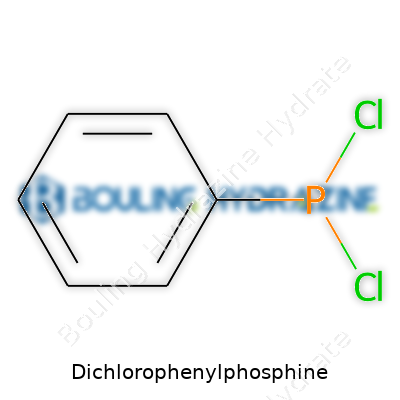
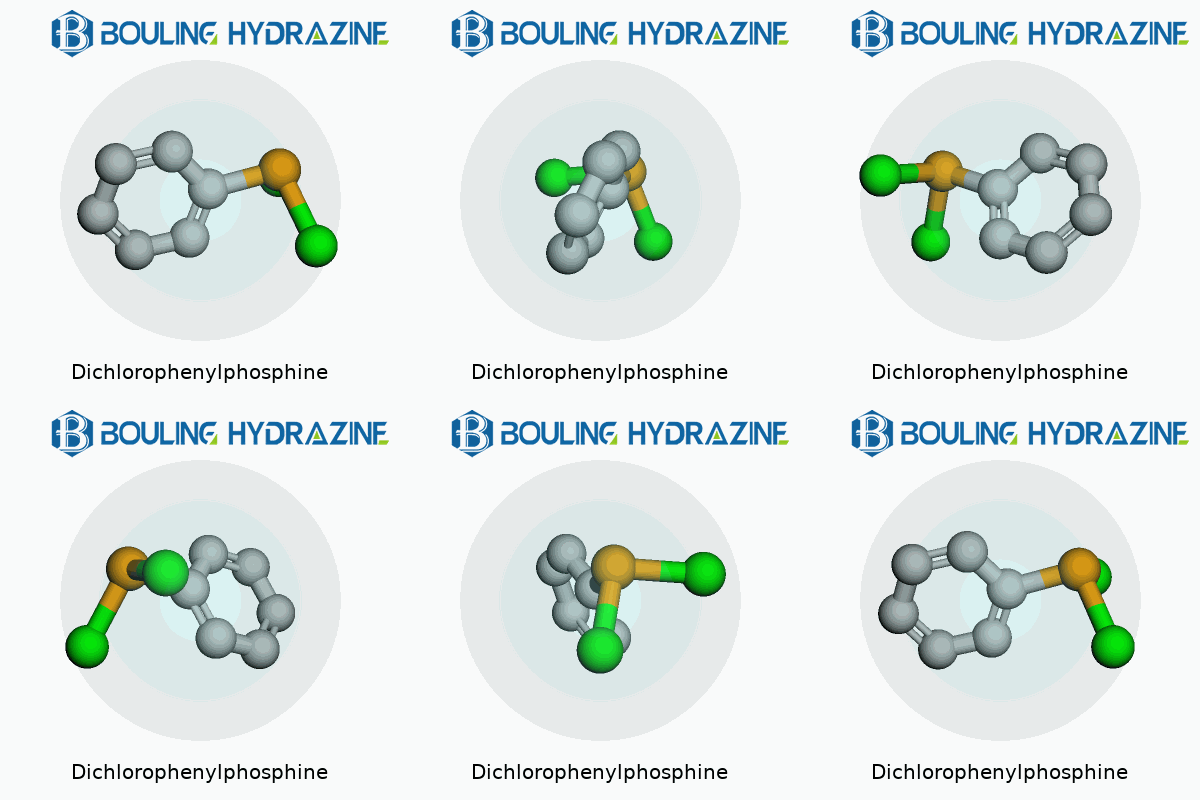
| Names | |
| Preferred IUPAC name | dichlorophenylphosphane |
| Other names |
Phenylphosphonous dichloride
Phenylphosphorus dichloride Dichlorophenylphosphane Benzenephosphonous dichloride Phosphonous dichloride, P-phenyl- |
| Pronunciation | '/daɪˌklɔːrəʊˌfɛnəlˈfɒsfiːn/' |
| Identifiers | |
| CAS Number | 644-97-3 |
| 3D model (JSmol) | C1=CC=C(C=C1)P(Cl)Cl |
| Beilstein Reference | 508075 |
| ChEBI | CHEBI:44203 |
| ChEMBL | CHEMBL146744 |
| ChemSpider | 21170133 |
| DrugBank | Not found |
| ECHA InfoCard | 100.011.395 |
| EC Number | 211-425-8 |
| Gmelin Reference | 1306 |
| KEGG | C19358 |
| MeSH | Phosphines |
| PubChem CID | 138725 |
| RTECS number | TB2478000 |
| UN number | 2798 |
| Properties | |
| Chemical formula | C6H5Cl2P |
| Molar mass | 178.985762 |
| Appearance | colorless to pale yellow liquid |
| Odor | pungent |
| Density | 1.319 g/mL |
| Solubility in water | Decomposes |
| log P | 2.7 |
| Vapor pressure | 0.4 mmHg at 20°C |
| Magnetic susceptibility (χ) | -97.5 × 10^-6 cm^3/mol |
| Refractive index (nD) | 1.559 |
| Viscosity | 1.3 mPa·s |
| Dipole moment | 1.83 D |
| Thermochemistry | |
| Std molar entropy (S⦵298) | 247.1 J/mol·K |
| Std enthalpy of formation (ΔfH⦵298) | -140.2 kJ/mol |
| Std enthalpy of combustion (ΔcH⦵298) | -3823.1 kJ/mol |
| Hazards | |
| Main hazards | Corrosive to skin, eyes and respiratory tract; toxic by ingestion/inhalation; reacts with water to release hydrogen chloride; lachrymator. |
| GHS labelling | Danger; GHS05, GHS07; H290; H302+H312+H332; H314; H335; P234; P260; P280; P301+P330+P331; P303+P361+P353; P304+P340+P310; P305+P351+P338; P390; P403+P233; P405; P501 |
| Pictograms | GHS05, GHS07 |
| Signal word | Danger |
| Hazard statements | H290 H302 H312 H314 H332 EUH014 |
| Precautionary statements | P260 P280 P301+P330+P331 P303+P361+P353 P304+P340 P305+P351+P338 P310 P405 P501 |
| NFPA 704 (fire diamond) | Health: 3, Fire: 1, Reactivity: 2, Special: W |
| Flash point | 102 °C |
| Autoignition temperature | 400 °C |
| Lethal dose or concentration | LD50: 500 mg/kg (oral, rat); LC50: 0.023 mg/L (inhalation, rat, 4h) |
| LD50 (median dose) | 200 mg/kg |
| NIOSH | TB2475000 |
| PEL (Permissible) | No PEL established. |
| REL (Recommended) | 0.02 ppm (0.15 mg/m3) |
| IDLH (Immediate danger) | 15 ppm |
| Related compounds | |
| Related compounds |
Phosphorus trichloride
Phenylphosphine Diphenylphosphine Triphenylphosphine |

Providing high-quality chemical products and logistics solutions for global trade partners.



